
Forsyth County Probate Records
North Carolina probate is handled by the Clerk of Superior Court, not by a separately named probate court. The N.C. Judicial Branch Estates help topic states that the elected Clerk of Superior Court in each county acts as probate judge. Elected clerks and assistant clerks hold most estate hearings and preside over most estate cases. If the validity of a will is challenged through a caveat proceeding, that caveat is heard by a Superior Court judge.
Forsyth County probate records can include wills filed after death, estate applications, preliminary inventories, letters testamentary, letters of administration, creditor notices, accountings, and estate orders. Guardianship, foreclosure, partition, and other special proceedings may also be clerk-related records. The public may see some estate information through the court portal or courthouse terminals, but sensitive guardianship and incompetency materials may not be fully public.
The Estates source is the central state reference for Forsyth County probate records because it explains the clerk's probate role.
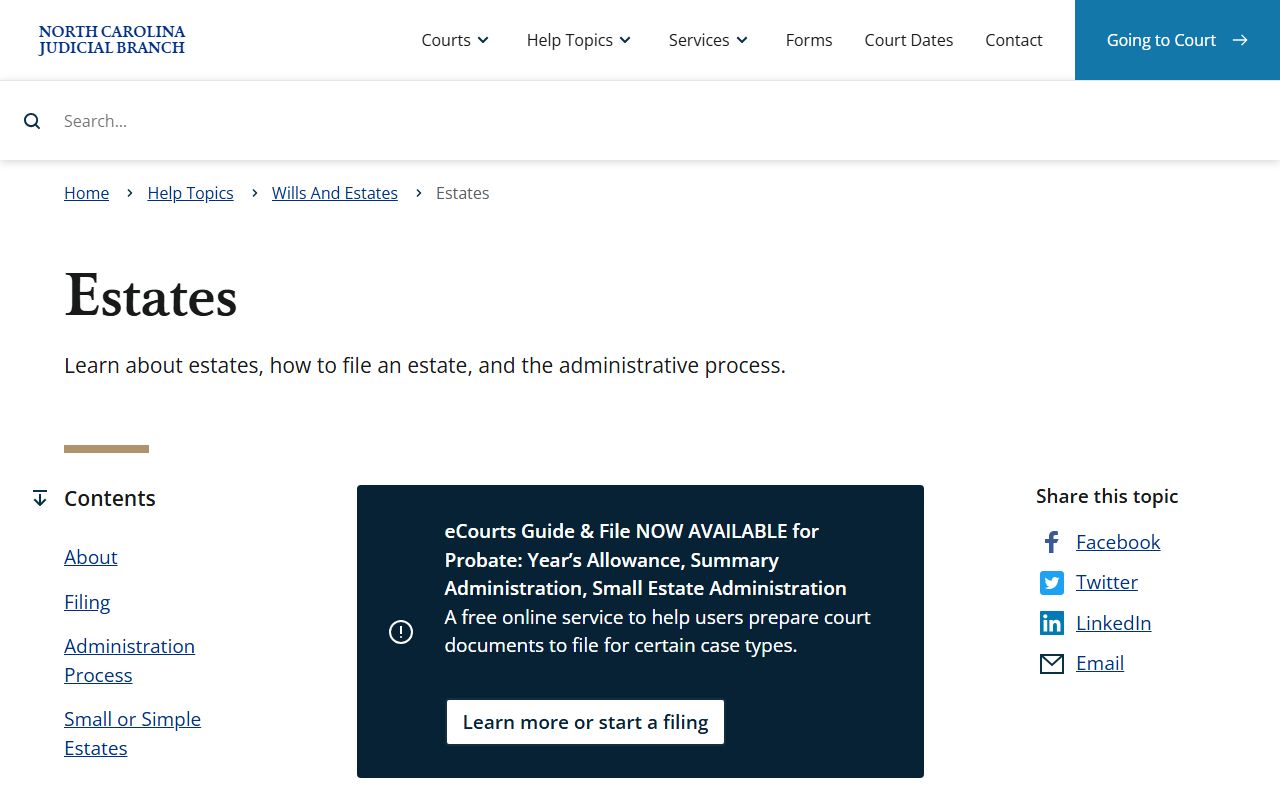
That state guidance matches the Forsyth County structure: estate administration runs through the Clerk of Superior Court.
Forsyth Probate Terms Defined
Probate records use terms that can be easy to confuse. The definitions below use the research glossary and the estate section, with North Carolina wording kept plain. These terms often appear in estate applications, letters, inventories, and clerk orders.
- Testator
- The person who made a will before death.
- Executor
- The person named in a valid will to carry out estate administration.
- Intestate
- A death without a qualifying will, which may lead to letters of administration.
- Guardianship
- Court-supervised authority to make decisions for an incompetent adult or minor.
- Conservatorship
- A protective financial role often discussed with guardianship-type proceedings, though the research uses guardianship and incompetency as the primary North Carolina access concern.
The Judicial Branch estate forms page is the state source for AOC-E series estate forms.
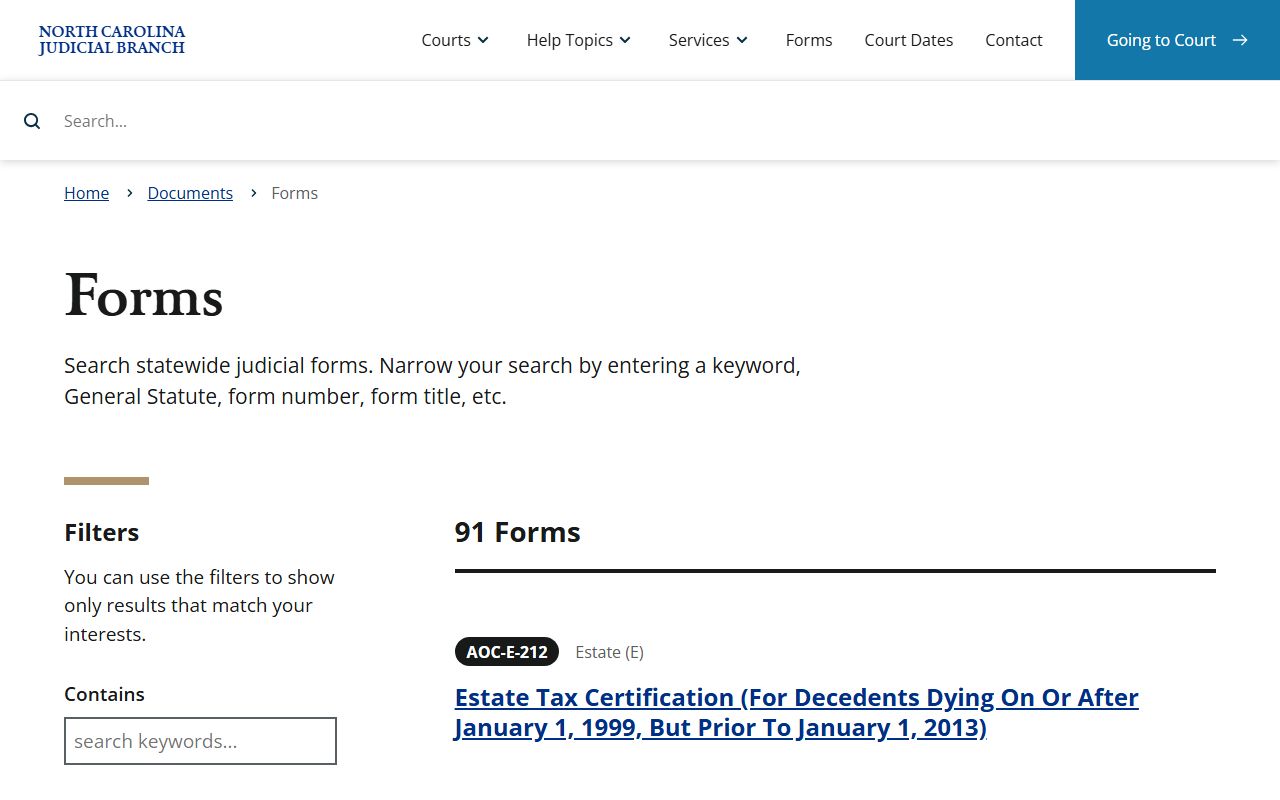
Those forms connect the definitions to the actual paperwork used for Forsyth County estate administration.
Search Forsyth County Probate Records
The probate access-channel sweep identifies several ways to search or request Forsyth County probate records. Online case information may be available through eCourts Portal for estate and special proceeding case information when available. Public self-service terminals at the clerk's office are another channel. Paper files and copy requests go through the clerk in the county where the estate is administered.
- Start with the decedent's name, estate name, case number if known, and Forsyth County as the county.
- Search eCourts Portal for estate or special proceeding case information when the record is available online.
- Use public self-service terminals at the Clerk of Superior Court when online results are incomplete.
- Request paper-file copies through the clerk if pleadings, orders, inventories, or certified copies are needed.
- Use state estate forms when opening or administering an estate, rather than trying to create informal paperwork.
Administration generally occurs in the county where the decedent was domiciled at death. If a nonresident died with North Carolina property, administration may occur in any North Carolina county where property or assets are located or have come into the county.
Forsyth County Probate Contact
There is one Forsyth County probate contact path in the research: the Clerk of Superior Court at the courthouse. The court directory lists an Estates Email and a Foreclosure / Guardianship Email, plus the main clerk number. Because the research did not provide the email addresses themselves, the contact card links to the official directory rather than inventing them.
Forsyth County Clerk of Superior Court
Estates, probate, guardianship, foreclosure, and special proceedings
175 N. Chestnut Street
Winston-Salem, NC 27101
(336) 779-6300
Probate Filing Fees
The research gives one specific opening-estate amount and confirms that copy requests carry per-page copy fees. It does not list separate amounts for letters, certified copies, guardianship filings, or every special proceeding fee. The table therefore separates researched amounts from items where the user must confirm the current amount with the clerk.
| Item | Amount or Rule |
|---|---|
| Application for letters with preliminary inventory | $120 filing fee |
| Letters testamentary | Issued to an executor under a valid will; separate amount not stated in research |
| Letters of administration | Issued to an administrator when there is no qualifying executor; separate amount not stated in research |
| Paper file copies | Copy requests go through the clerk, and per-page copy fees apply |
| Guardianship or incompetency records | Access may be restricted because files can contain medical and financial information |
Note: Probate copy and filing costs can change, so the clerk's office is the control source for current amounts.
What Forsyth Probate Records Show
After a person dies, a will may be filed with the clerk of court. The Judicial Branch states that a decedent's will becomes a public record when filed after death, and any person may view a public record or request a copy for a fee. North Carolina does not require a formal meeting for the reading of the will. To begin administration, a person generally gathers the will if any, a certified death certificate, information about assets, and contacts the clerk in the proper county.
A Forsyth County estate file may show the decedent, applicant, heirs or devisees, executor or administrator, filed will, application, preliminary inventory, letters, creditor notices, accountings, and orders. The file may also show whether the case is a standard estate, a special proceeding, or a related guardianship matter. Court portal results may show case information, but paper-file inspection or copy requests may be needed for full documents.
The Chapter 130A vital-record statutes are relevant when a certified death certificate or other vital-record proof is needed for estate work.
Vital-record rules do not replace probate records, but death-certificate proof may be part of the estate opening process.
Restricted Forsyth Probate Records
Most estate filings are public once filed, but not every probate-related file is fully open. Guardianship and incompetency records may contain medical, financial, and personal information. Those limits can affect what appears online, what a public terminal shows, and what a clerk can release without party status, legal authority, or a court order. Sealed records and confidential identifiers are also outside ordinary public access.
Bankruptcy is not a Forsyth County probate proceeding. The Middle District of North Carolina Bankruptcy Court is a separate federal court source when an estate, heir, creditor, or decedent's debt issue overlaps with a bankruptcy case.
The bankruptcy source is included because probate assets and creditor issues can touch federal bankruptcy records without becoming county probate files.
The NC Vital Records certificate channel is separate from Forsyth County probate records and from Clerk of Superior Court estate files.
Use vital-record channels for state certificates, and use the clerk for estate files, probate orders, and special proceeding records.