
Forsyth County District Court Overview
Forsyth County is in District Court District 31. District Court sits within North Carolina's unified General Court of Justice, along with Superior Court and the appellate courts. The District Court Division hears civil, criminal, juvenile, and magistrate matters and sits in each county seat. For Forsyth County, that means District Court cases are handled through the courthouse in Winston-Salem, with court records maintained by the Clerk of Superior Court.
District Court is the practical entry point for many common court records. It handles misdemeanors and infractions without jury trials, most traffic cases, divorce, custody, child support, juvenile matters, small claims through magistrates, landlord-tenant eviction cases, and civil matters under the District Court jurisdiction level. Felony trials and larger civil cases belong in Superior Court, although a criminal case may begin with magistrate or District Court events before moving upward.
The N.C. Judicial Branch District Court page describes the state-level role of District Court in civil, criminal, juvenile, and magistrate matters.
Forsyth County District Court records can include ordinary case files as well as matters connected to treatment-oriented court programs.
Forsyth County District Court Contacts
North Carolina does not use numbered county courts or justice courts like some states. Forsyth County's District Court functions operate through District Court District 31, magistrates, juvenile court, custody mediation, and related courthouse offices. The contact directory lists these functions at the Forsyth County Courthouse rather than as separate municipal court buildings.
| Court Function | Type | Address | Phone |
|---|---|---|---|
| District Court Judges | District Court | 175 N. Chestnut Street, Winston-Salem, NC 27101 | (336) 779-6318 |
| Clerk of Superior Court | District and Superior Court records | 175 N. Chestnut Street, Winston-Salem, NC 27101 | (336) 779-6300 |
| Magistrates - Small Claims | Small claims and magistrate matters | 175 N. Chestnut Street, Winston-Salem, NC 27101 | (336) 779-6319 |
| Juvenile Court | Juvenile District Court matters | 175 N. Chestnut Street, Winston-Salem, NC 27101 | (336) 779-6311 |
| Custody Mediation | Family court process | 175 N. Chestnut Street, Winston-Salem, NC 27101 | (336) 779-6613 |
| Court-Ordered Arbitration | Civil process | 175 N. Chestnut Street, Winston-Salem, NC 27101 | (336) 779-6318 |
District Court Superior Court Magistrates
The main Forsyth County comparison is District Court versus Superior Court versus magistrate matters. There is no separate Forsyth County municipal court for state court cases. Police agencies may issue citations, create reports, or publish warrant data, but the court case routes into the statewide court structure.
| District Court | Superior Court | Magistrates | |
|---|---|---|---|
| Civil Scope | Divorce, custody, child support, and civil cases involving less than $25,000 | Larger civil matters and appeals where assigned | Small claims of $10,000 or less, evictions, personal property recovery, and motor vehicle mechanics' liens |
| Criminal Scope | Misdemeanors and infractions without jury trials | Felony criminal trials and general-jurisdiction criminal matters | Initial appearances, release conditions, and some warrants |
| Family and Juvenile | Domestic and juvenile matters | Selected appeals or matters assigned by law | Not the primary family court forum |
| Records Custodian | Clerk of Superior Court | Clerk of Superior Court | Clerk-related court records and magistrate records where filed |
Forsyth County District Case Flow
District Court case flow depends on case type. A traffic citation may begin with an officer's ticket and proceed to waiver, payment, online reduction, dismissal review, or a court appearance. A misdemeanor may begin with arrest, citation, warrant, or magistrate process and move through first appearance, hearings, plea, trial before a judge, disposition, and sentence. A civil case begins with filing and service, then moves through answer, motions, mediation or arbitration when assigned, hearing, and judgment.
Criminal flow: Arrest or citation › Magistrate or first appearance › District Court hearing › Plea or bench trial › Disposition › Sentence or appeal.
Civil flow: Complaint or petition filed › Service › Answer › Motions or mediation › Hearing or trial › Judgment › Appeal when allowed.
Small claims flow: Claim filed › Magistrate hearing › Judgment › Appeal to District Court if properly taken.
Forsyth County District Record Types
Forsyth County District Court records can include misdemeanor files, infraction files, traffic citations, domestic records, child custody and support papers, divorce files, juvenile records, landlord-tenant cases, small claims appeals, and lower-value civil suits. Some documents are public. Others are restricted because they involve minors, adoption, protected identifiers, domestic violence safety issues, sealed filings, expunction, or sensitive medical and mental-health facts.
Juvenile matters are especially limited. Juvenile delinquency, undisciplined, abuse, neglect, dependency, and termination-of-parental-rights records are not ordinary public records. Access is generally limited to parties, attorneys, agencies, or persons with statutory authority or a court order. That restriction should be expected even when the same courthouse handles public traffic and civil matters.
- Traffic citations and infractions usually route through District Court and clerk payment processes.
- Misdemeanor criminal records may show charges, hearings, pleas, dispositions, costs, and sentence terms.
- Domestic records may include divorce, custody, support, equitable distribution, and domestic violence filings.
- Civil District Court files may include complaints, summonses, answers, motions, orders, judgments, and arbitration papers.
- Juvenile District Court records are restricted and should not be treated as normal public case files.
Forsyth County District Calendars
District Court dates can be searched through the eCourts hearing tools and through local administrative schedules. The Forsyth County local administrative schedules page links Superior Court administrative schedules, civil calendars, criminal calendars, an attorney divorce calendar appointment link, and Portal case and hearing search. Local rules and forms also include District Court case management plans, equitable distribution rules, short motions and absolute divorce calendar materials, chambers rules, interpreter orders, and continuance policies.
Calendars are not the same as full case records. A calendar or hearing search may show date, time, courtroom, and basic case information. The case file may contain pleadings, motions, orders, and judgments that require Portal access, a public terminal, or the clerk's paper file. For missed court, bond, warrant, or compliance questions, calendar data should be checked against the case file and the clerk's office.
Forsyth County Magistrate Records
Magistrates are part of the lower-court path in North Carolina. In civil matters, magistrates may try small claims of $10,000 or less, landlord eviction cases, suits to recover personal property, and motor vehicle mechanics' liens. In criminal matters, magistrates may handle initial appearances, release conditions, warrants, and other first-stage matters assigned by law.
Magistrate activity can create or affect District Court records. A person arrested on a warrant may be booked at the detention center, appear before a magistrate, receive release conditions, and then have District Court dates scheduled. A small claims judgment may later be appealed to District Court. Warrant and release records may also overlap with sheriff and jail systems.
Forsyth County Recovery Courts
Forsyth County has local treatment-oriented programs tied to court and custody pathways. Mental Health Court is described by the Stepping Up Initiative as a court-supervised treatment program for offenders with mental illness who agree to participate. SUPER focuses on people incarcerated in the Forsyth County Detention Center and offers screening, recovery planning, peer support, and case management.
Veterans Court Services began in Forsyth County in 2016 and was formerly called Forsyth County Veterans Treatment Court. Statewide recovery-court materials describe veterans treatment courts and adult treatment courts as programs for participants with substance-use, mental-health, or co-occurring disorders. These programs may affect case handling for eligible defendants, but they are not public search portals.
The N.C. Judicial Branch Adult Treatment Court page explains the statewide recovery court model for repeat offenders with treatment needs.
District Court and criminal records should distinguish public case events from confidential treatment details.
The Veterans Treatment Court page gives the statewide context for military-service veterans in treatment-focused court programs.
Forsyth County's local veterans services information should be verified before visiting because one public defender-related source still used an old courthouse address.
Forsyth County Court Programs
The Forsyth County Mental Health Court page describes the local court-supervised treatment program for defendants with mental illness.
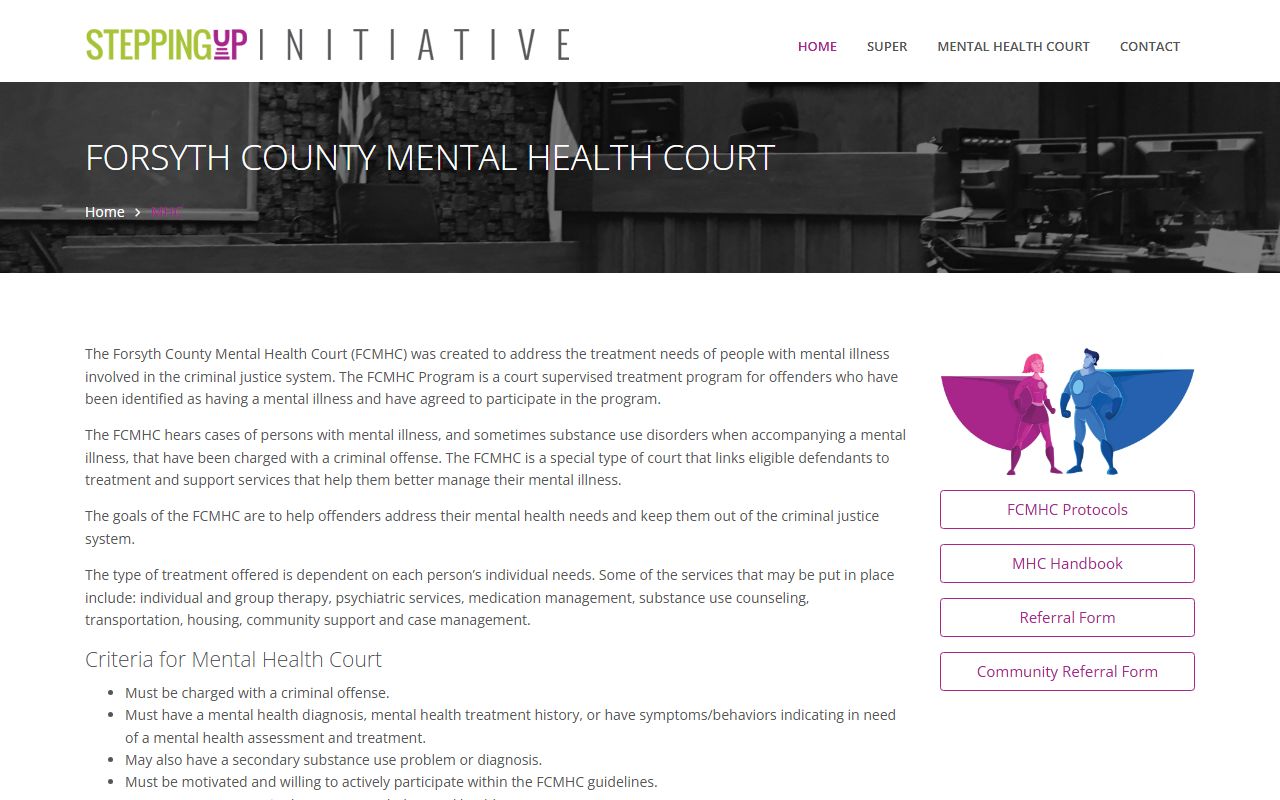
Records from treatment court participation may contain sensitive behavioral-health information and should not be treated like ordinary public docket content.
The Forsyth County Stepping Up Initiative connects local court, jail, and behavioral-health work through SUPER and Mental Health Court.
This local program context helps explain why some criminal records may include treatment-oriented orders or referrals.
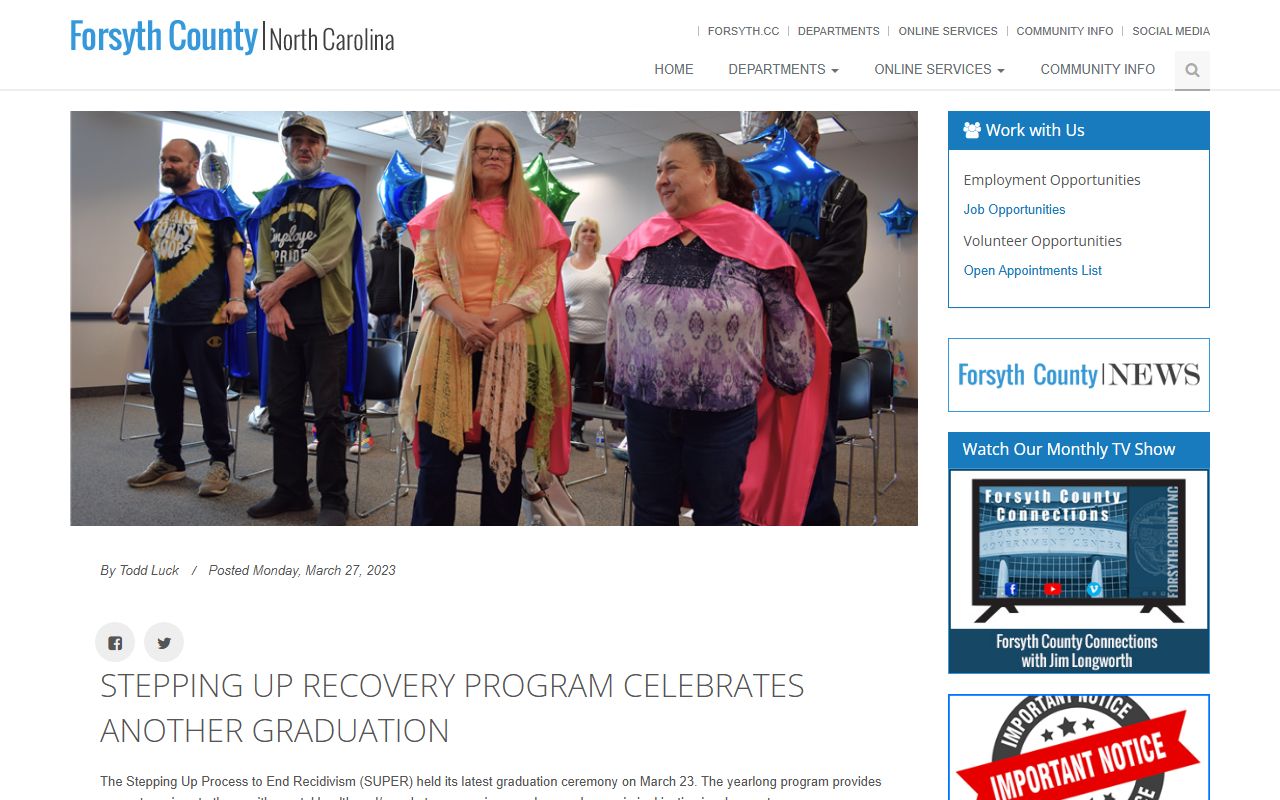
A county article on a SUPER graduation described the program as a yearlong effort for people with mental health or substance-use issues who may have criminal-justice involvement.
Program news is useful background, but case status and court orders still need to be checked through the clerk or Portal.