
Search Forsyth County Court Records
Forsyth County court records are searched first through the statewide eCourts Portal, not through a county-only case database. The Portal gives public access to Smart Search for case information, Search Hearings for court dates and hearings, Make Payments for some probation, parole, criminal, and infraction cases, and NC Judgment Search. The Forsyth County Judicial Branch page also links court-date search tools and local calendars.
Online search is only one channel. The N.C. Judicial Branch states that criminal, civil, special proceeding, and estates case information can be searched on public self-service terminals at clerk offices. Paper files are inspected through the Clerk of Superior Court in the county where the case is located. The Portal also warns that background checks should be handled through the county clerk's office rather than relying on Portal results alone.
- Open the eCourts Portal and choose Smart Search for case information or Search Hearings for a court date.
- Use a party name, case number, citation number, county, or date range when those fields fit the search.
- Review the case type, parties, hearing dates, and docket events that are public for that matter.
- Use a public terminal or visit the Forsyth County Clerk of Superior Court when online results do not show the file or document needed.
- Request certified copies from the clerk when a court, agency, school, employer, or title office requires an official record.
The N.C. Judicial Branch court structure overview explains why Forsyth County cases route through statewide court divisions rather than a local city court system.
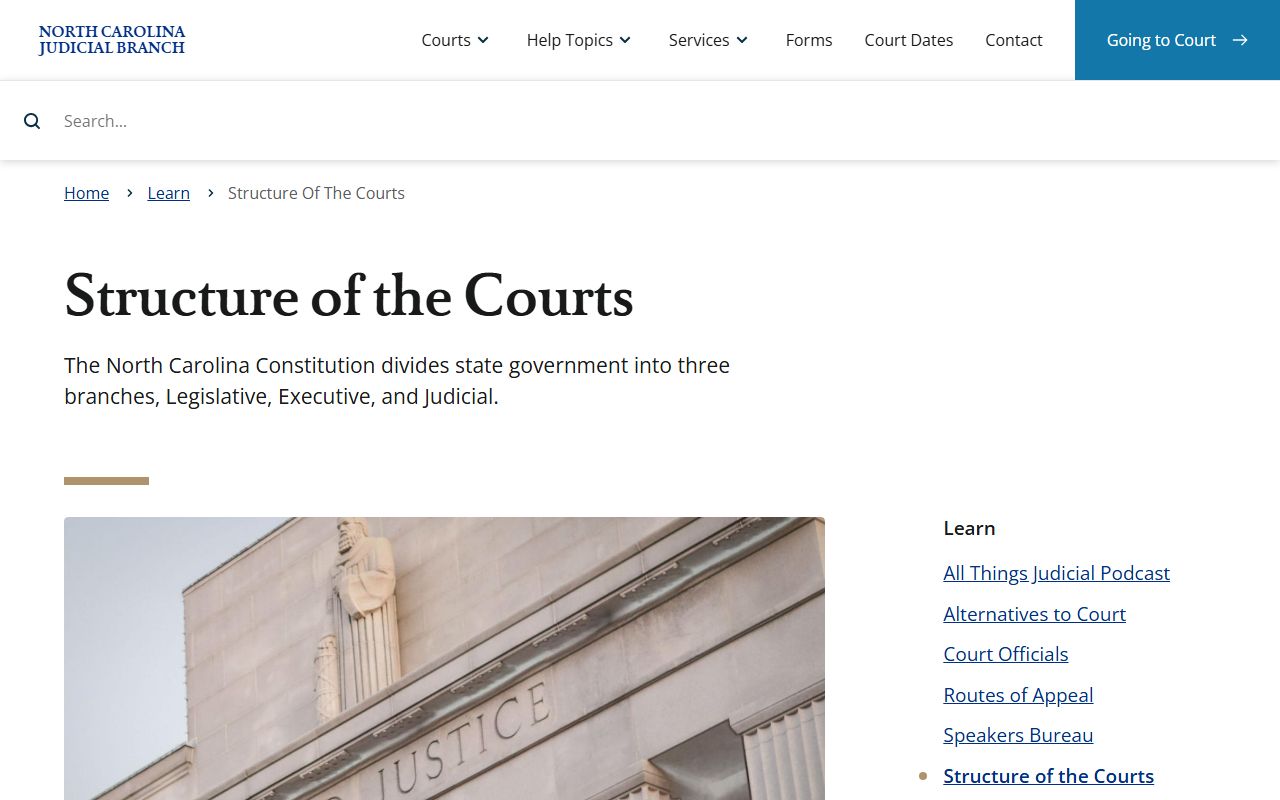
That structure matters because searches may point to District Court, Superior Court, the Clerk of Superior Court, or an appellate court depending on the record.
The official eCourts Portal is the main online search entry for Forsyth County court records, hearings, payments, and judgment lookup.
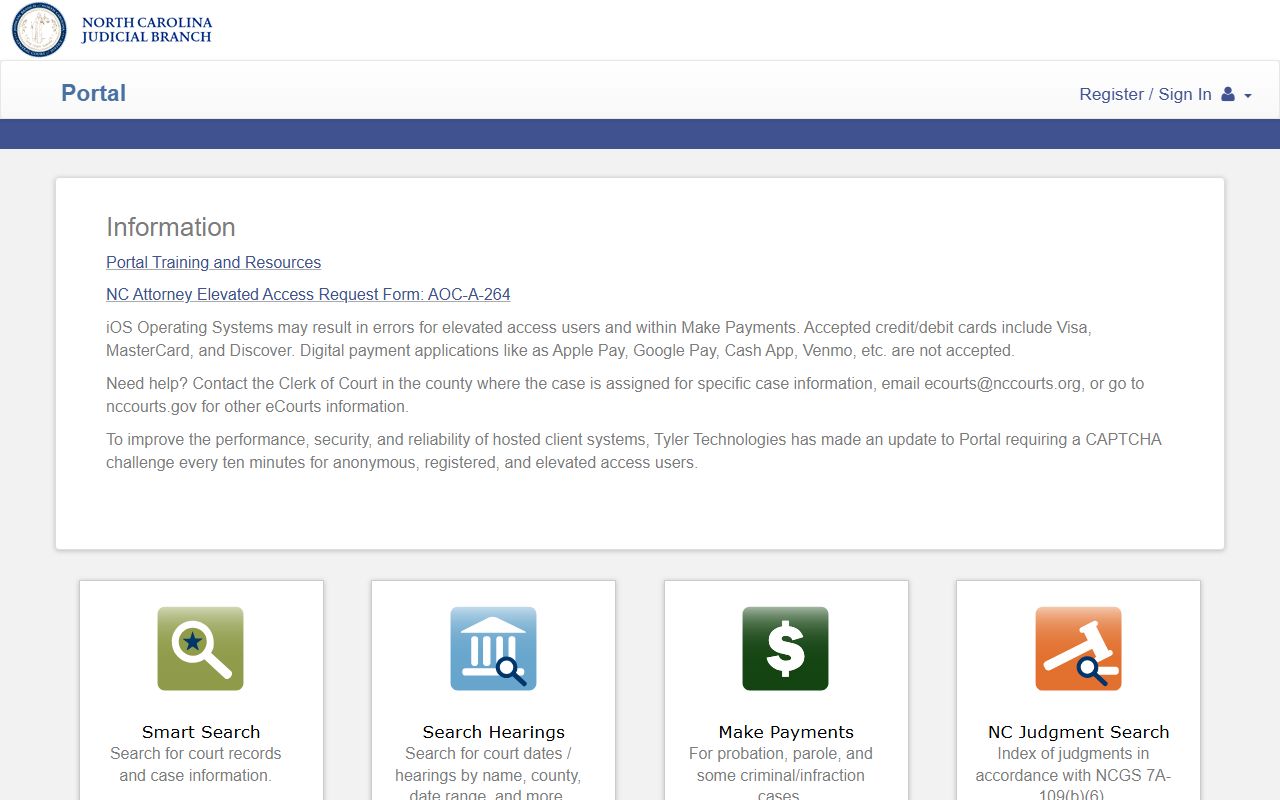
Portal results should be treated as a search path, while certified copies and full file review still depend on clerk access.
Forsyth County Court Search Fields
The public Portal is JavaScript-driven, but the research confirms the main actions visible from the landing page. Users may register or sign in, yet public search options are also shown. CAPTCHA checks may repeat during a session, and Portal help directs case-specific questions to the county clerk or the eCourts email channel.
| Field Label / Control | Type | Required | Options / Format Notes |
|---|---|---|---|
| Smart Search | Tile/link | No | Searches court records and case information. |
| Search Hearings | Tile/link | No | Searches court dates and hearings by name, county, date range, and more. |
| Make Payments | Tile/link | No | For probation, parole, and some criminal or infraction cases. |
| NC Judgment Search | Tile/link | No | Judgment index under N.C.G.S. 7A-109(b)(6). |
| CAPTCHA challenge | Security control | Periodic | Required every ten minutes for anonymous, registered, and elevated users. |
Forsyth County Judicial System
Forsyth County is in Prosecutorial District 31, Superior Court District 31, and District Court District 31. North Carolina's General Court of Justice has an Appellate Division, Superior Court Division, and District Court Division. Superior Court handles felony criminal trials, larger civil matters, some appeals, and other general-jurisdiction cases. District Court handles misdemeanors, infractions, traffic citations, family law, juvenile matters, small claims through magistrates, landlord-tenant cases, and civil matters within its jurisdiction.
There is no separate municipal court system for state cases in Forsyth County. Municipal police agencies may keep police reports, crash reports, incident records, and warrant information, but court filings route through the North Carolina court system. Federal matters are separate and go through the U.S. District Court for the Middle District of North Carolina, with a Winston-Salem federal courthouse downtown.
| Court or Office | Role | Forsyth County Record Types |
|---|---|---|
| Superior Court | General jurisdiction trial court | Felony cases, larger civil cases, appeals, selected special matters |
| District Court | Lower trial court | Misdemeanors, infractions, traffic, family, juvenile, small claims, evictions |
| Clerk of Superior Court | Unified clerk and probate judge | Court files, certified copies, estates, special proceedings, payments |
| Magistrates | Judicial officers | Small claims, evictions, initial appearances, warrants, release conditions |
Case flow: Magistrate or filing › District Court or Superior Court › North Carolina Court of Appeals › Supreme Court of North Carolina when review is allowed or accepted.
The District Court overview describes the lower trial court work that makes up much of the Forsyth County Court record volume.
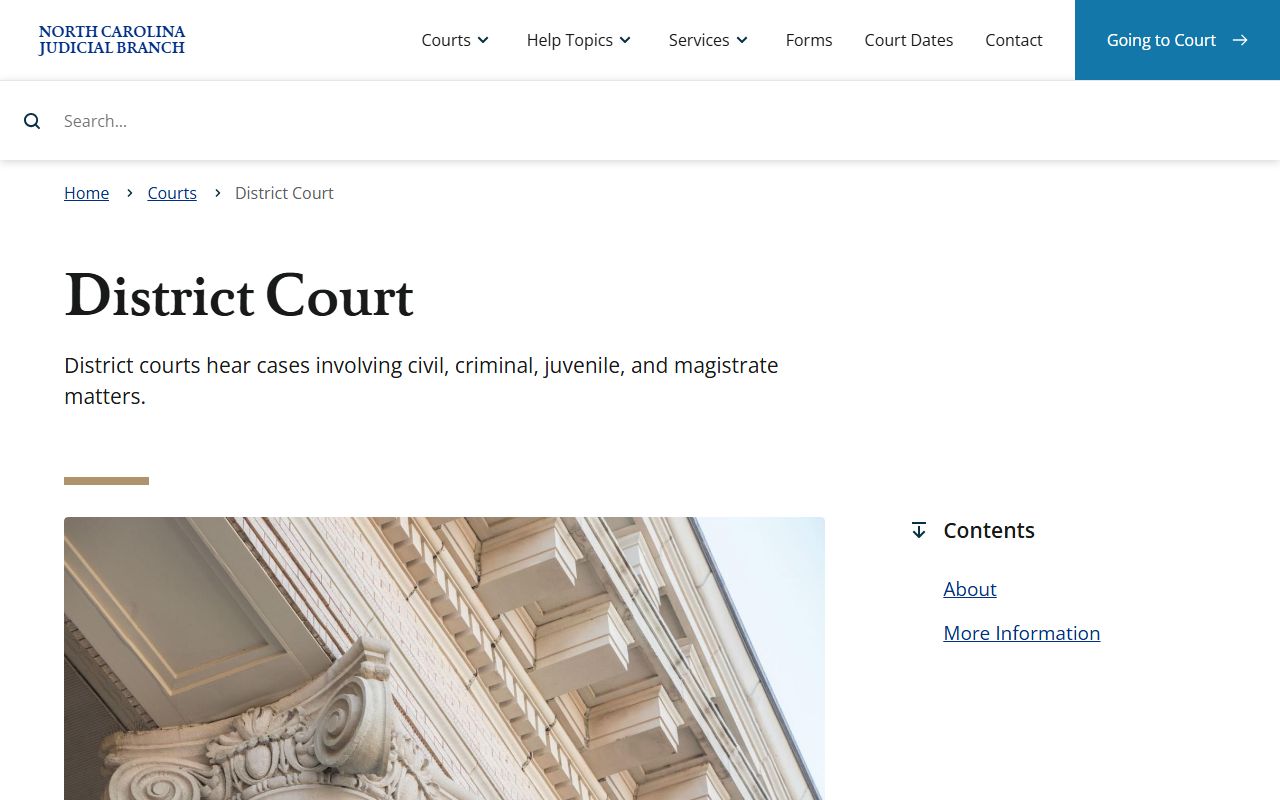
That state description lines up with Forsyth County's local mix of traffic, misdemeanor, family, juvenile, small-claims, and civil matters.
Forsyth County Courthouse Records
The main public courthouse is the Forsyth County Courthouse at 175 N. Chestnut Street in Winston-Salem. The courthouse phone is (336) 779-6300, and the mailing address is Forsyth County Courthouse, PO Box 20099, Winston-Salem, NC 27120. Public courthouse hours are Monday through Friday, 8:00 a.m. to 5:00 p.m.; the Clerk of Superior Court's Office is posted as open 8:30 a.m. to 5:00 p.m.
Court operations moved into the new courthouse in October 2023. The old courthouse at 200 North Main Street closed to the public on October 20, 2023, and the new courthouse opened October 23, 2023. That move matters when older records, summonses, or local-rule documents still refer to the former Hall of Justice or older Main Street location.
Forsyth County Courthouse
175 N. Chestnut Street
Winston-Salem, NC 27101
(336) 779-6300
Public hours: Monday-Friday, 8:00 a.m.-5:00 p.m.
Forsyth County Clerk of Superior Court
175 N. Chestnut Street
Winston-Salem, NC 27101
(336) 779-6300
Office hours: 8:30 a.m.-5:00 p.m.
Law Enforcement Detention Center
201 North Church Street
Winston-Salem, NC 27101
(336) 917-7600
County jail and custody questions
The official Forsyth County Courthouse page is the current address source for in-person court records and clerk visits.
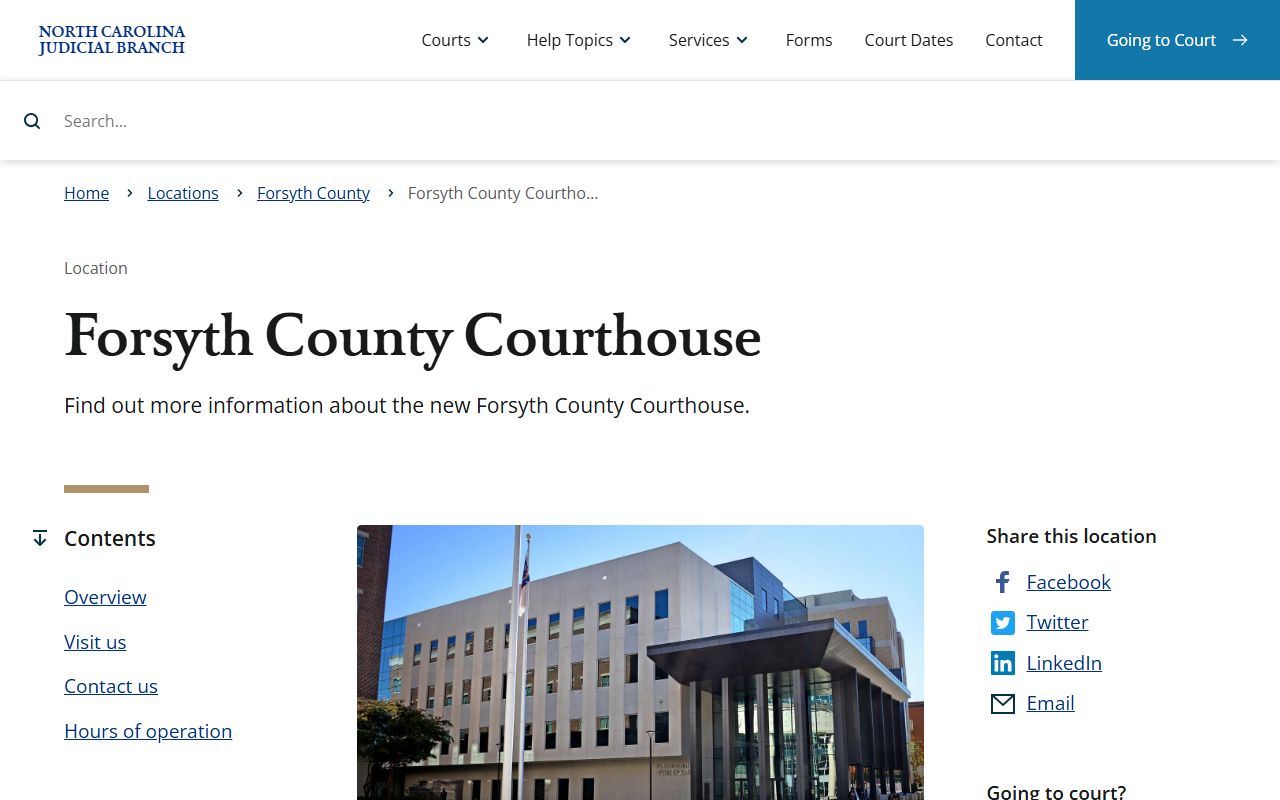
The courthouse sits in the downtown government campus near the jail, Government Center, and sheriff offices.
The county-specific N.C. Judicial Branch Forsyth County page collects courthouse links, calendars, payment information, jury service, and local rules in one official place.
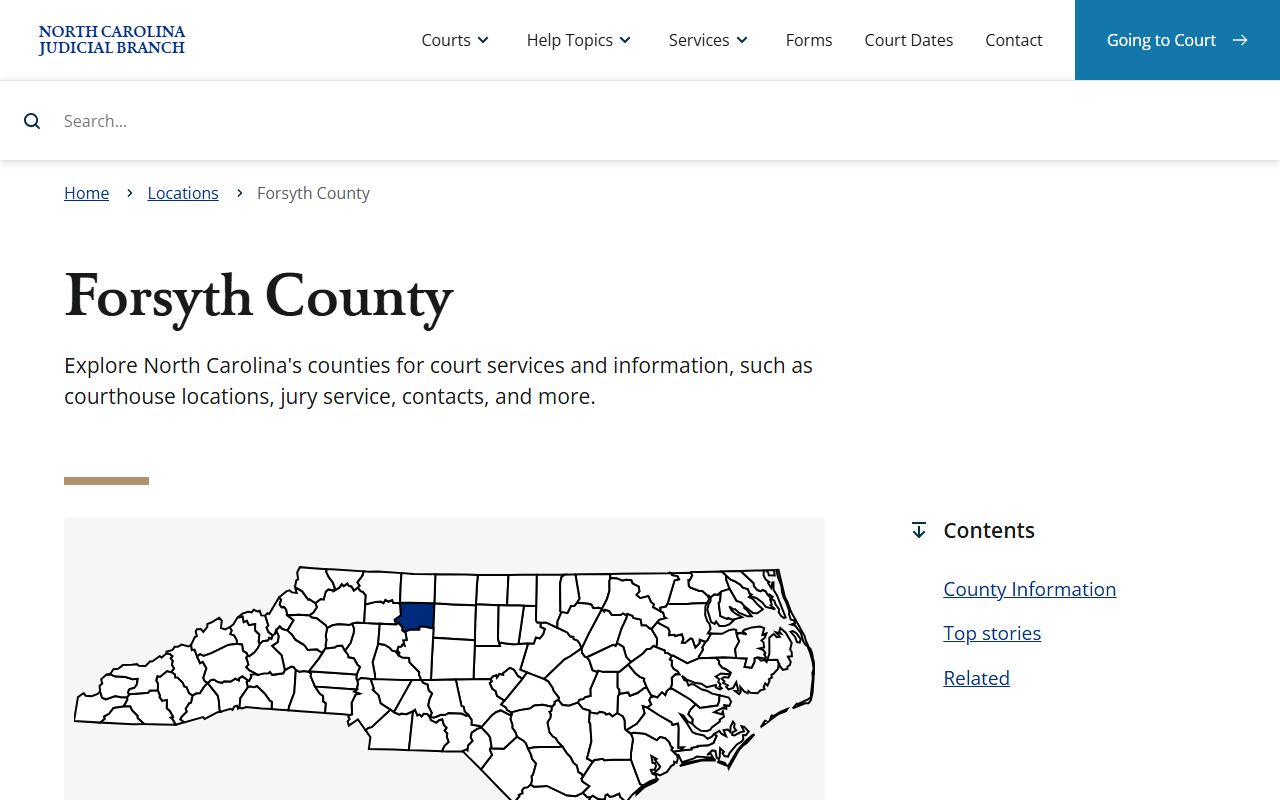
That county page is often the shortest route from a general search to the correct local court service.
Forsyth County Court Record Types
Forsyth County court records include criminal, civil, family, traffic, probate, estates, guardianship, special proceeding, and judgment records. Criminal court records can include warrants, magistrate orders, indictments, pleas, hearings, dispositions, sentencing judgments, probation conditions, and financial obligations. Civil court files may include complaints, summonses, answers, motions, orders, judgments, settlements, arbitration papers, and hearing notices.
Some records belong to non-court custodians. Marriage licenses and certified marriage certificates are handled by the Forsyth County Register of Deeds or NC Vital Records. Sheriff arrest, jail, incident, and wanted-person information is handled by the sheriff or the police agency that created the record. State prison, probation, and parole data is separate from the county jail roster.
- Criminal records: District Court misdemeanors and infractions, Superior Court felonies, and related criminal filings.
- Civil records: Lawsuits, small claims, evictions, domestic matters, judgments, and court orders.
- Traffic records: Citations, court dates, waivers, dispositions, costs, and DMV-reportable outcomes.
- Estate records: Wills after death, letters, inventories, accountings, and clerk orders.
- Vital-related court records: Divorce judgments are court records, while marriage licenses are Register of Deeds records.
The N.C. Judicial Branch court-records help topic explains the difference between online case information, public terminals, and paper files held by the clerk.
For certified copies or file inspection, the clerk remains the key source even when online search is useful.
What Forsyth County Court Records Show
A court record is more than a name search result. It can show who filed a case, which court division handled it, when the case started, what hearings were scheduled, what motions or orders were entered, and how the case ended. Criminal records may show charges, pleas, bond, sentence, probation, and restitution. Civil records may show claims, parties, service, orders, judgments, liens, and money awards.
| Field | What It Shows |
|---|---|
| Case Number | The unique court identifier used for Portal, public terminal, and clerk searches. |
| Court and County | Forsyth County plus the Superior Court or District Court division when public. |
| Parties | Defendants, plaintiffs, petitioners, respondents, decedents, guardians, or attorneys. |
| Docket Events | Filings, hearings, continuances, orders, warrants, returns, pleas, and compliance events. |
| Disposition | The outcome of a charge, claim, motion, citation, or petition. |
| Financial Information | Fines, costs, bond, restitution, judgment amounts, or payment eligibility when public. |
Forsyth County Court Records Laws
North Carolina public access starts with the rule that existing public records must be available for inspection and copies unless a law restricts them. Court records also have court-specific rules, redaction limits, fee rules, and confidentiality categories. The practical question is not just whether a record exists, but which office holds it and which access channel applies.
Key Statutes:
N.C.G.S. 132-6 requires public-record inspection and copies as promptly as possible at reasonable times, subject to fees and exceptions.
N.C.G.S. 132-6.2 limits copy and service fees and does not require agencies to create records that do not exist.
N.C.G.S. Chapter 7A governs court record keeping and supports remote public access under NCAOC procedures.
N.C.G.S. Chapter 15A includes expunction rules that can remove eligible criminal records from public access.
Fee information should be checked with the clerk before ordering. The research confirms that court copies are subject to statewide clerk fees, while public agencies are not required to create or compile a record that does not already exist.
Restricted Forsyth County Court Records
Not every Forsyth County court record is public. Juvenile delinquency, abuse, neglect, dependency, termination-of-parental-rights, adoption, sealed, expunged, certain mental-health, and protected personal-identifier records are restricted. Guardianship and incompetency files may also include sensitive medical or financial information that is not open in the same way as a normal civil filing.
Expunction is a court process, not a database edit. Eligibility depends on the charge, disposition, conviction type, waiting period, prior record, and statute. A person seeking expunction usually starts with the N.C. Judicial Branch expunction materials and the Clerk of Superior Court in the county of the case. If an order is granted, public court and law-enforcement records are removed or restricted under that order.
Forsyth County Specialty Courts
Forsyth County has treatment-oriented court and court-adjacent programs that can affect criminal records, court charges, warrants, and custody outcomes. The Forsyth County Mental Health Court is described by the Stepping Up Initiative as a court-supervised treatment program for offenders with mental illness who agree to participate. The broader SUPER program focuses on people incarcerated in the county detention center and provides screening, recovery planning, peer support, and case management.
The Judicial Branch also describes Adult Treatment Courts and Veterans Treatment Courts as recovery-court models for people with substance-use, mental-health, or co-occurring disorders. These are not public lookup databases. They are local or statewide intervention paths tied to eligibility, court supervision, and treatment needs.
Forsyth County Sheriff Records
The Forsyth County Sheriff's Office is led by Sheriff Bobby F. Kimbrough, Jr. and operates the Law Enforcement Detention Center. The jail is an adult maximum-security facility with a 1,016-bed capacity. Sheriff and jail records are not the same as court files, but they often connect to warrants, arrests, first appearances, bond, and current custody.
The official online jail lookup is the Forsyth Sheriff P2C Inmates Catalog. The sheriff also maintains a P2C Wanted Persons Catalog. The Forsyth Co. Sheriff's Office mobile app is another sheriff access channel and is listed in both the Apple App Store and Google Play with tools for information, reporting, resources, and sheriff contacts.
The Forsyth County Sheriff's Office site is the official starting point for local law-enforcement records and jail links.
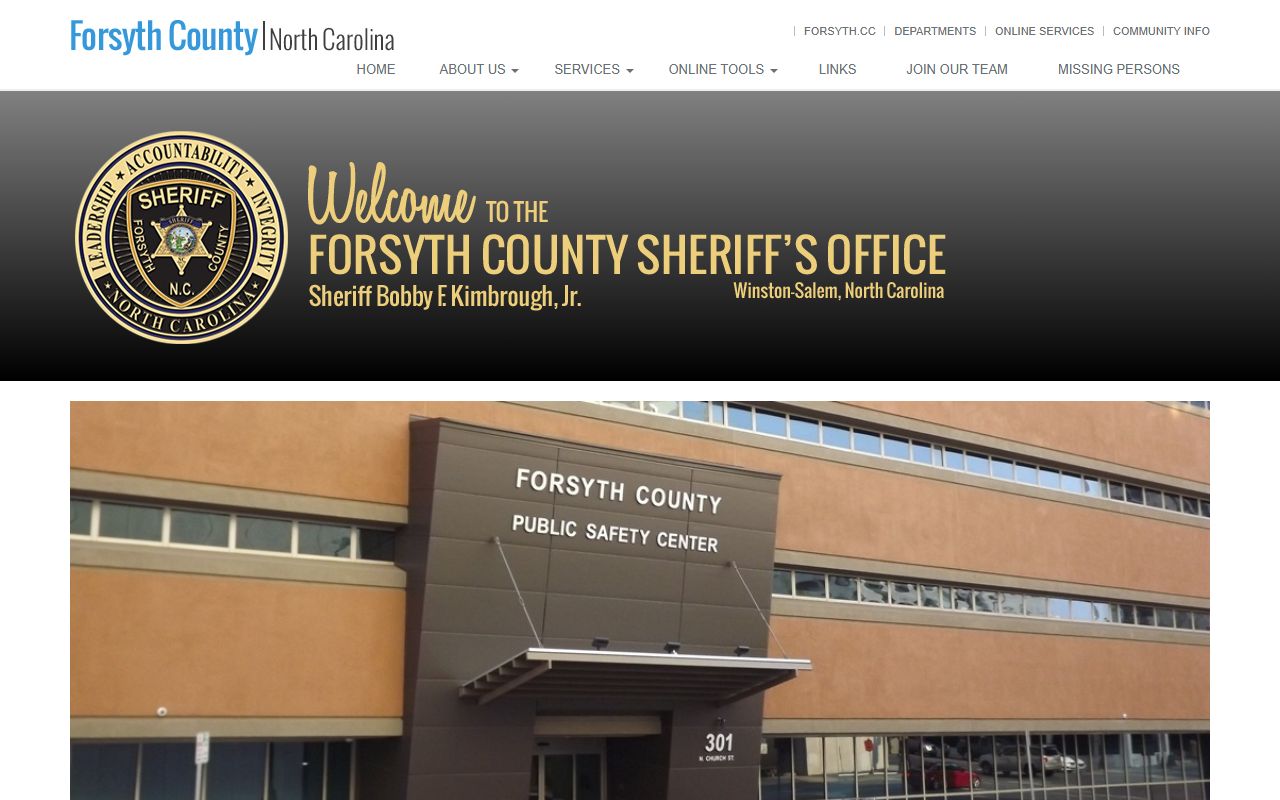
Sheriff records can help locate custody and warrant status, but case outcomes still belong with the court and clerk.
Forsyth County Marriage Divorce Probate
Marriage records are handled by the Forsyth County Register of Deeds, not the court clerk. The Register of Deeds office issues marriage licenses, keeps marriage license records, and provides certified copies. Divorce judgments and divorce case files are court records through the Clerk of Superior Court. Estate and special proceeding records are also clerk-related because the Clerk of Superior Court acts as probate judge in North Carolina.
Forsyth County Register of Deeds online lookup is useful for recorded and vital-record indexes, while certified marriage certificates may require the Register of Deeds, Permitium ordering, mail, walk-in service, or NC Vital Records. Estate files may require Portal, a public terminal, or clerk contact. Divorce judgments require the clerk in the county where the divorce was granted.
- Estate
- The property and obligations left by a deceased person.
- Executor
- The person named in a will and authorized by the clerk to administer an estate.
- Letters testamentary
- Clerk-issued proof that an executor has authority to act for an estate.
- Guardianship
- Court-supervised authority to make decisions for an incompetent adult or minor.
The Forsyth County Register of Deeds is the county office for marriage licenses and certified vital records.
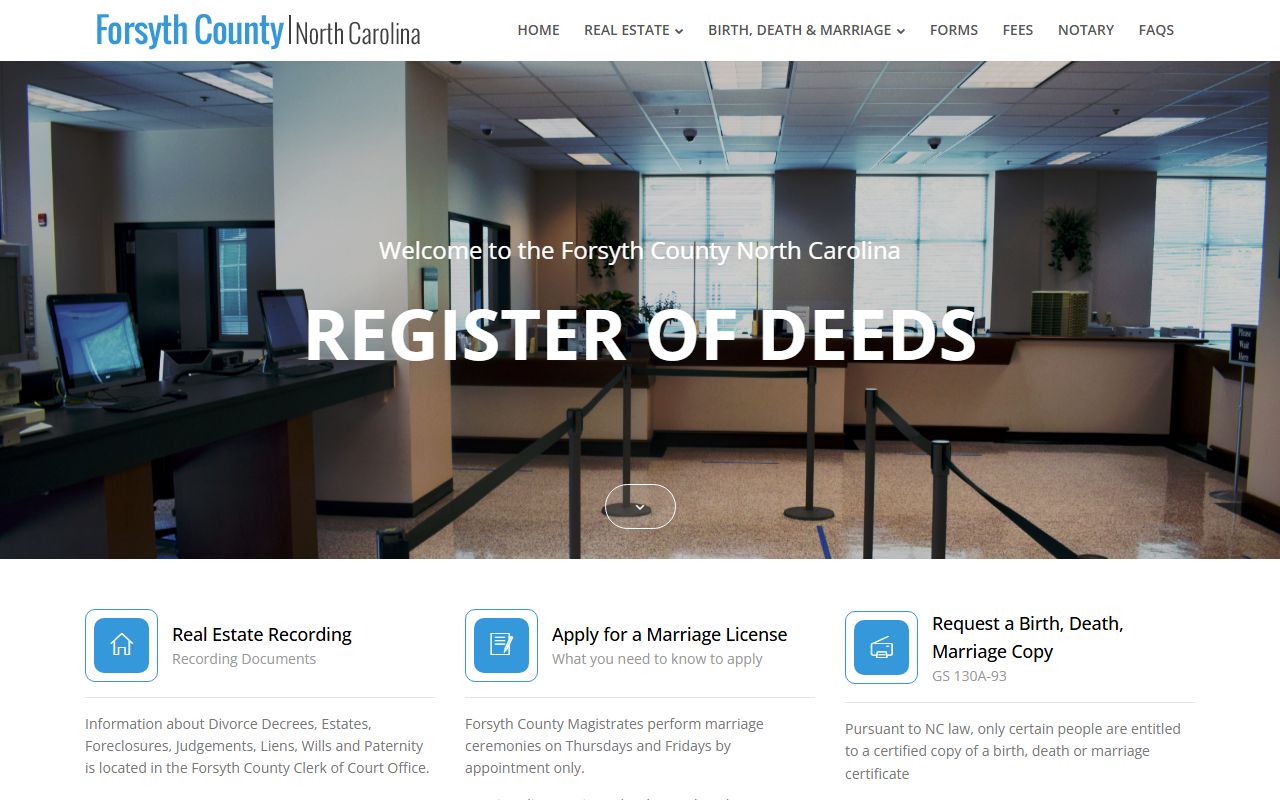
Use the court clerk for divorce judgments and estates, and the Register of Deeds for marriage license records.
Forsyth County Court Records Fees
Forsyth County court payments and copy requests use different channels depending on what is being paid or ordered. The research confirms court copy fees are charged under the statewide fee chart, but it does not provide a specific per-page court copy amount. It does provide local payment methods and several vital-record and marriage fees.
| Item | Amount or Rule |
|---|---|
| Marriage license | $60 |
| Marriage license plus certified copy | $70 total |
| Register of Deeds certified vital copy walk-in | $10 |
| Register of Deeds uncertified copy walk-in | $0.50 |
| Permitium certified copy order | $15.11 per copy plus convenience charges |
| Court copy fees | Charged by the clerk under statewide miscellaneous fee rules |
Forsyth County Court History
Forsyth County was formed in 1849. The Register of Deeds record-history timeline says early records were copied by hand from 1849 to 1904, typed from 1904 to 1929, microfilmed beginning in 1954, and indexed by computer beginning in 1965. Older record searches may therefore require different methods from modern Portal search or online Register of Deeds lookup.
The 2023 courthouse move is the most important recent court-access change. A file, summons, or older local-rule reference may still mention the former 200 North Main Street courthouse, while current court visits should use the 175 N. Chestnut Street courthouse.
Forsyth County's official county government site links broader county services, including the Government Center, Register of Deeds lookup, property information, and other records that may connect to court judgments, estates, and liens.
County records can support court research when a case involves real property, estate assets, recorded documents, or local agency files.
The N.C. Judicial Branch courthouse move release documents the public transition into the new courthouse.
Clerk and court officials remain central to older record searches because online databases may not show every historic file.
Forsyth County Court Records FAQ
Can I search Forsyth County court records online?
Yes. Public case and hearing searches start with the eCourts Portal. Some records still require a public terminal, clerk visit, or certified copy request because online search is not a complete paper-file replacement.
Who is the Forsyth County court clerk?
The elected Clerk of Superior Court is Denise Hines. The clerk's office handles court record keeping for Superior Court and District Court and also acts as judge of probate for estates and related special proceedings.
Where are Forsyth County inmates searched?
Current county jail custody is searched through the Forsyth Sheriff P2C Inmates Catalog or by calling the Law Enforcement Detention Center. State prison, probation, and parole records are separate NCDAC records.
Are warrants public in Forsyth County?
Some active warrant and wanted-person information appears through the Forsyth Sheriff P2C and Winston-Salem Police P2C systems. Sealed, juvenile, unserved, and investigative warrants may not be public.
Where are marriage records kept?
Marriage licenses and certified marriage copies are handled by the Forsyth County Register of Deeds or NC Vital Records. Divorce judgments are court records through the Clerk of Superior Court.