
Forsyth County Arrest Records and Court Charges
Arrest records in Forsyth County come from the agency that makes the arrest or holds the person in custody. The Forsyth County Sheriff's Office operates the county jail and maintains sheriff law-enforcement channels. Sheriff Bobby F. Kimbrough, Jr. is identified in the research as the county sheriff. The Law Enforcement Detention Center is the custody facility for male and female sentenced misdemeanant and pretrial inmates. Those facts are not the same as a court charge. The charge record begins when criminal process or a charging document moves into the North Carolina court system.
For a person who needs the booking side, the Forsyth Sheriff's Police-to-Citizen Inmates Catalog is the official county jail lookup. For the filed case side, the Clerk of Superior Court and the N.C. Judicial Branch maintain the court record. The full case file, plea, sentence, and disposition belong with Forsyth County criminal court records. The arrest-to-charge path runs through arrest, process, filed charge, status, and access limits.
The N.C. Department of Adult Correction image in the manifest points to the state criminal-offender search channel. The NCDAC criminal offender searches page is separate from Forsyth County jail and court files.
Use that state channel for prison, probation, parole, and offender history questions, not as a replacement for the Forsyth County court charge record.
Search Forsyth County Charges After Arrest
Forsyth County charge lookup requires more than one channel because arrest, custody, prosecutor review, and court filing are held by different offices. The sheriff can show custody or wanted-person information. The Clerk of Superior Court and N.C. Judicial Branch court systems show the public court case when a public record exists. The District Attorney decides how the State will prosecute criminal charges in District Court and Superior Court. Research identifies Forsyth County as Prosecutorial District 31, with District Attorney Jim O'Neill listed through the North Carolina Conference of District Attorneys.
- Start with the sheriff or police source if the question is whether the person was arrested, booked, or listed as wanted.
- Use the public court case channel or clerk process to find the filed case, case number, court division, and charge list.
- Read each charge as a separate accusation. One arrest can produce several charge entries.
- Check the current status, disposition, bond, court date, and any public-access restriction before relying on the result.
The official Forsyth Co. Sheriff's Office app is also a mobile access channel. The research documents the iOS app and Android app. The app description says users can report issues or concerns with photos and reach community resources, crime-prevention links, online reporting, and sheriff information. A sheriff social announcement described the app as including inmate search, an interactive crime map, FAQs, division contacts, and more.
The manifest includes the sheriff app store pages because mobile sheriff information may fill gaps when a desktop record search does not answer the arrest question. The Forsyth Co. Sheriff's Office App Store listing is an official mobile source identified in the research.
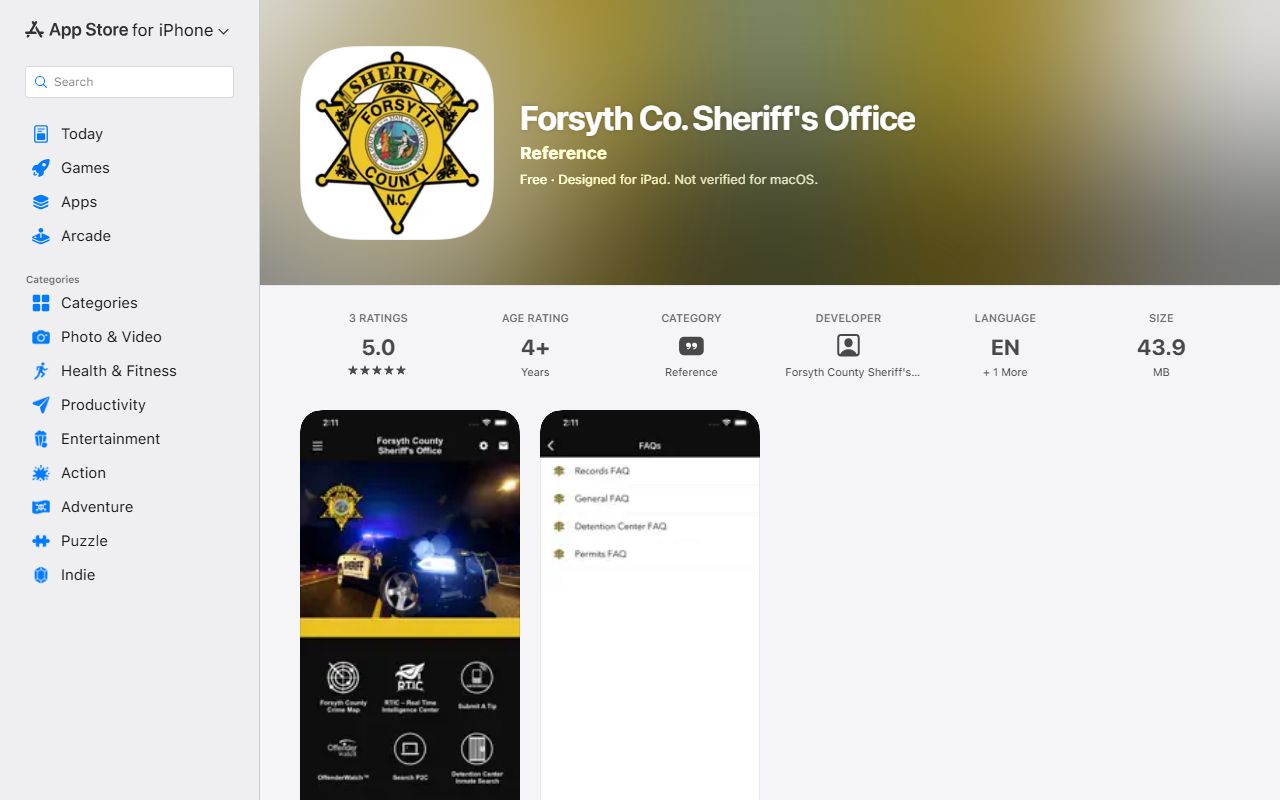
The app is best treated as an extra sheriff access point, while court charge status still needs the court or clerk source.
Forsyth County Charging Documents
A charge after arrest is the formal accusation that moves into the court record. North Carolina criminal records can include warrants, magistrate orders, indictments, informations, pleadings, orders, pleas, trial settings, dispositions, sentencing judgments, probation conditions, financial obligations, and appeal entries. A magistrate may issue process or set release conditions after arrest. The District Attorney then decides how to prosecute state criminal charges.
| Document | Who Uses It | How It Fits the Charge Record |
|---|---|---|
| Complaint or magistrate process | Law enforcement, complainant, or magistrate process | May start the criminal process and connect the arrest to a court case or warrant record. |
| Information | Prosecutor | A formal prosecutor-filed accusation where allowed by procedure and case posture. |
| Indictment | Grand jury | A formal felony accusation returned by a grand jury, often tied to Superior Court felony prosecution. |
The U.S. Attorney image in the manifest reflects federal context, not ordinary Forsyth County state charges. The U.S. Attorney for the Middle District of North Carolina handles federal prosecutions in the district.
Most local arrest-to-charge questions still route through the sheriff, District Attorney, Clerk of Superior Court, and state trial courts.
Forsyth County Charge Status Terms
Charge records change as the case moves. A charge can remain pending, be amended, be reduced, be dismissed, or end in a plea, verdict, or sentence. The research uses disposition as the outcome of a case or charge. A person reading a Forsyth County arrest record should not treat the first charge line as the final result. The filed charge may not match the final judgment.
| Status | What It Means | What to Check Next |
|---|---|---|
| Pending | The accusation is still open or awaiting court action. | Look for the next hearing, court division, and bond or release condition. |
| Amended or reduced | The filed charge changed from its earlier wording or severity. | Compare the original charge with the current charge and final disposition. |
| Dismissed | The charge did not proceed to conviction in that case record. | Check whether other charges from the same arrest remain open. |
| Disposition entered | The court has recorded an outcome such as a plea, verdict, judgment, or sentence. | Read the sentence, costs, probation, restitution, and appeal entries if public. |
Note: Database updates can lag after dismissal, recall, bond posting, or court action, so verify with the originating court or agency.
Forsyth County Charges Versus Convictions
A charge is not a conviction. A charge is an accusation filed after arrest or criminal process. A conviction is a finding or admission of guilt. North Carolina criminal records may show both, but they answer different questions. This distinction matters for background checks, employment screening, and personal review because an arrest and charge can be public even when the case later ends in dismissal or another non-conviction result.
| Point | Charge | Conviction |
|---|---|---|
| Record stage | Appears when the State files or maintains an accusation. | Appears after plea, verdict, or other judgment of guilt. |
| What it proves | It proves an accusation exists, not that the person is guilty. | It records a final or enforceable outcome tied to guilt. |
| Where to verify | Check case events, charge status, and the clerk record. | Check the judgment, sentence, probation, costs, and appeal entries. |
The Forsyth Co. Sheriff's Office Google Play listing is the Android app source in the image manifest.
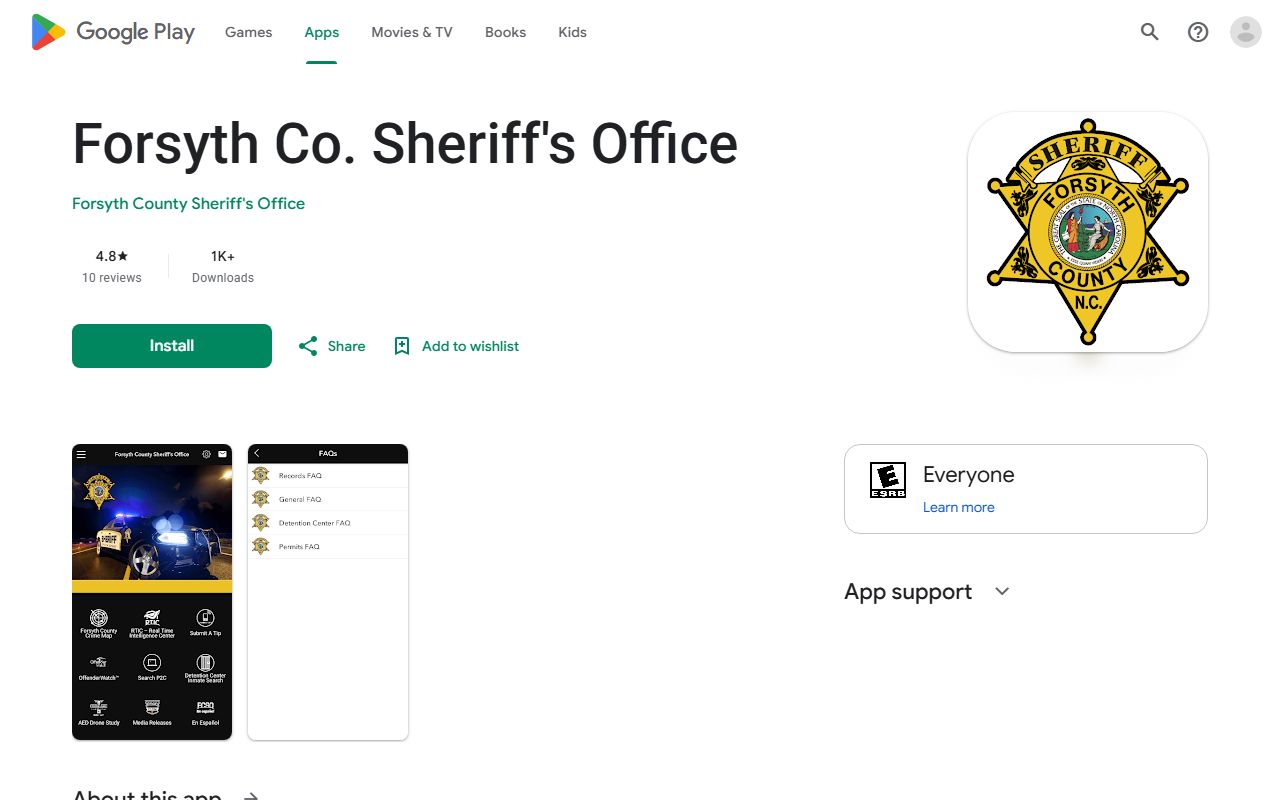
Mobile sheriff information can help locate custody or reporting tools, but the court record remains the place to confirm conviction status.
Restricted Forsyth County Charge Records
North Carolina public-record rules do not make every charge detail public. Juvenile delinquency, undisciplined, abuse, neglect, dependency, and termination-of-parental-rights records are not ordinary public files. Sealed records are hidden from general public access. Expunged criminal records are removed from public access under court order and statutory rules. Public copies also normally redact Social Security numbers, financial account numbers, protected minor information, and similar identifiers.
Public access authority in the research includes N.C.G.S. 132-6, which requires public inspection and copies at reasonable times subject to exceptions, and N.C.G.S. 132-6.2, which limits copy and service fees and does not require an agency to create a record that does not exist. Expunction rules are governed through Chapter 15A, with eligibility based on charge, disposition, waiting period, prior record, and statute.
Important: Do not use casual arrest or charge lookups for FCRA-regulated employment, tenant, credit, insurance, or similar screening.